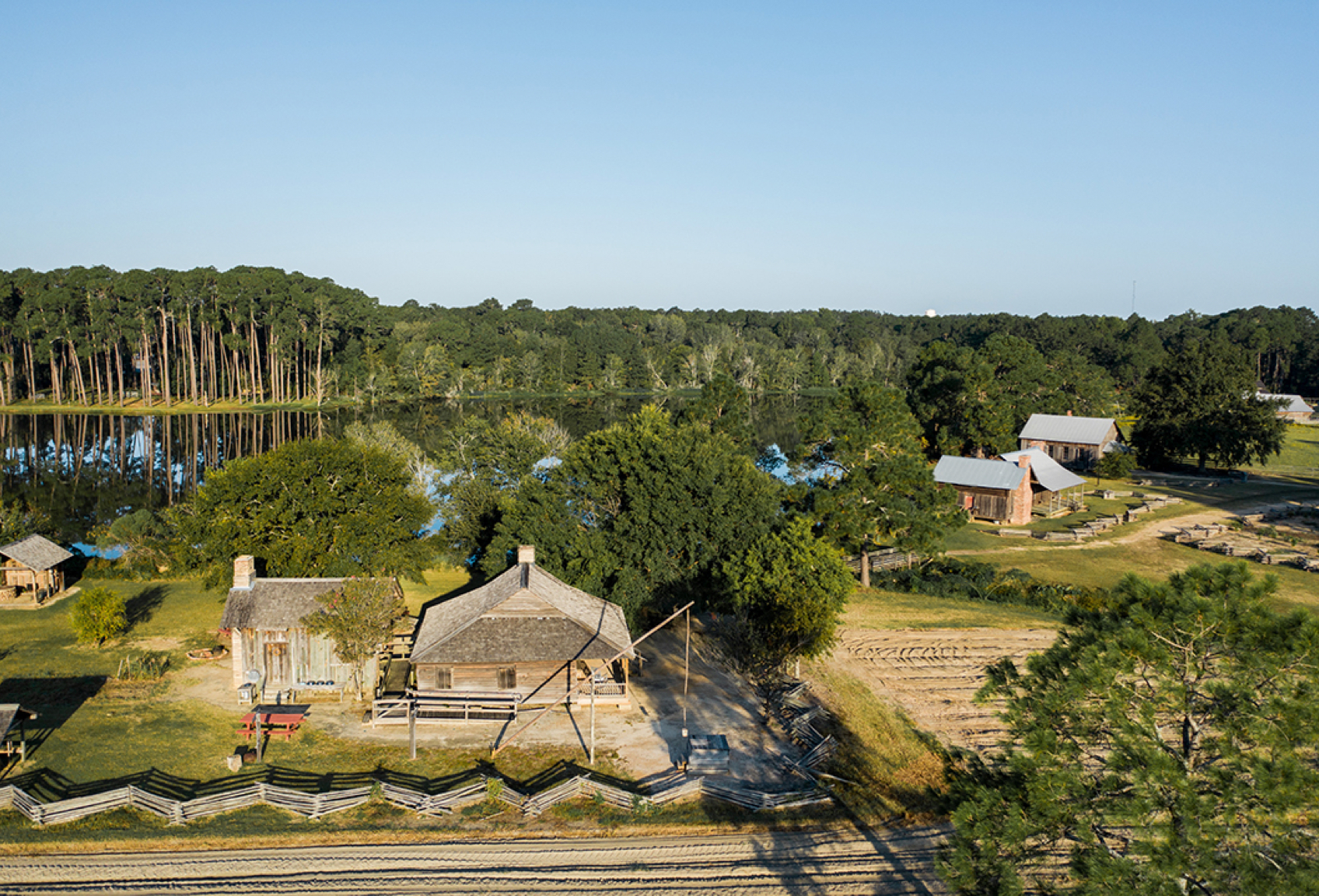
Clark Cabin - 1870s
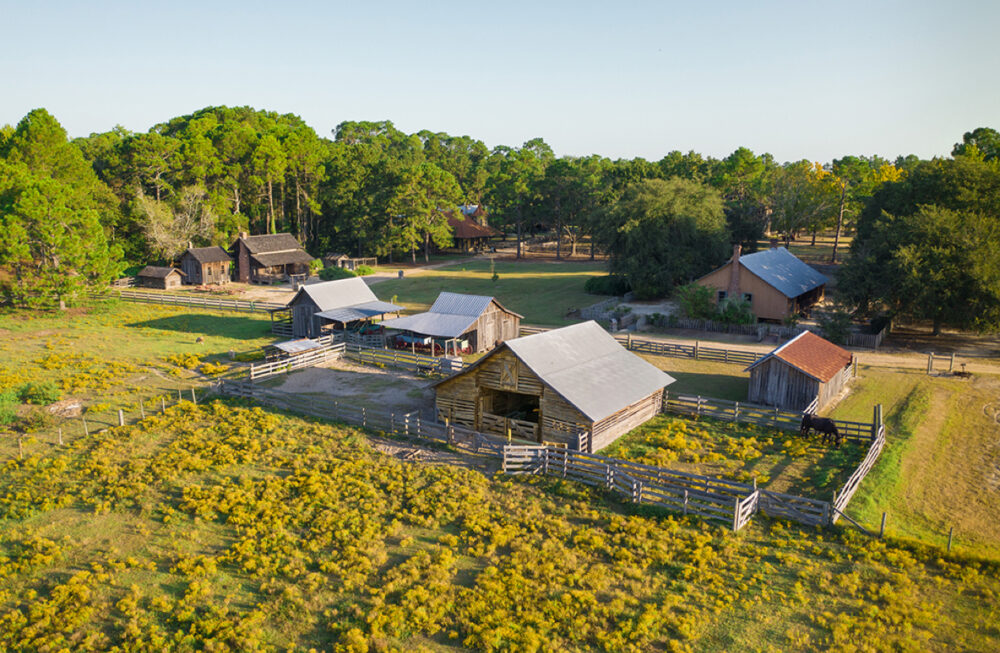
The Clark Cabin is a reconstructed example of a traditional Wiregrass Georgia farmstead, reflecting the simple, self-sufficient lifestyle common across the state during the late 19th century. The term "traditional" refers to the generational farming practices passed down from the area's early settlers. This farm setup is typical of what would have been found in the 1870s—before the arrival of the railroad and the growth of the turpentine and lumber industries transformed the region. The Clark Cabin site includes several key features of a working farm from that era: a wash shed for laundry, a sugarcane mill and syrup kettle used to make syrup on-site, and an outhouse.
Sumner Clyatt Cabin - 1850
The Sumner Clyatt Cabin, originally located in northwest Tift County between Chula and the Whiddon Grist Mill, was generously donated by Mrs. R.L. Clyatt. Built around 1850 by James C. Sumner, the cabin marks a significant moment in his life—the same year he married Mary Branch on February 24. The couple had several children, including their daughter Mary Elizabeth, who later married Ben Cravey. Their home, known as the Cravey House, is also preserved at the Georgia Museum of Agriculture.
Simon's Cabin & James' Kitchen - 1845 / 1867
The Simon’s Cabin is the larger portion of this historic structure, featuring two floors and originally built around 1845 by Simon Royal in Land Lot 75 of the 14th Land District, Pateville Community, Crisp County, Georgia. It was likely constructed as a double-pen log cabin with a central breezeway—commonly known as a dogtrot—typical of the architectural style of the time. Attached to the Simon’s Cabin is the James Kitchen, built in 1867 by Elder James “Babe” Gibbs, an ordained Primitive Baptist minister. The James Kitchen was originally part of a double-pen cabin, though only one half was salvageable. While it began as a log structure, its exterior was later covered with vertical boards and battens, possibly to improve water resistance or for aesthetic appeal.
Sand Hill School House - 1895
Built around 1895 near Ty Ty, Georgia, the Sand Hill School House was constructed by Johnny Gibbs as a private school for his children and his brother’s children who lived nearby. In the late 1800s, nearly every rural settlement had a school of some kind, often operating during the agricultural “off-season” when children weren’t needed on the farm. By the mid-1890s, Georgia’s state curriculum included subjects such as spelling, reading, writing, arithmetic, geography, history, and English grammar. A major milestone came in 1901, when a state law introduced local taxation to support county-wide rural education.
The Museum’s Sand Hill School House offers a glimpse into what education looked like in the late 19th and early 20th centuries. Step inside to see how students of all ages learned together in a single room—and maybe even join in on a lesson yourself!
Wesley Chapel - 1882
This structure is representative of a church in a small rural community but it was also referred to as a meeting house, and considered the chief structure in a rural settlement. The Wesley Chapel was constructed c. 1882 in northeast Dougherty County, Georgia, near the community of Acree. It was donated by the South Georgia Methodist Conference, Rev. C.E. Cariker, District Superintendent, and three trustees, George J. Kirksey, Mrs. A.L. Bolton, and John H. Johnson. The congregations of these churches were small and scattered, so church was often one of the few places residents saw neighbors and friends. Because of this, churches often hosted events such as dinner on the grounds and all-day church or sings. Following the preacher’s sermon, the congregation would adjourn to the lawn outside of the church for a meal. Churches in this time period did not usually have a full-time minister and were served by a circuit-rider preacher, who was at one church on one Sunday and at another church on the next. Many times the circuit rider would stay with a member of the congregation in what was often referred to as the traveler’s room. A representation of a room such as this is located at the Gibb’s House.
Continue Exploring